
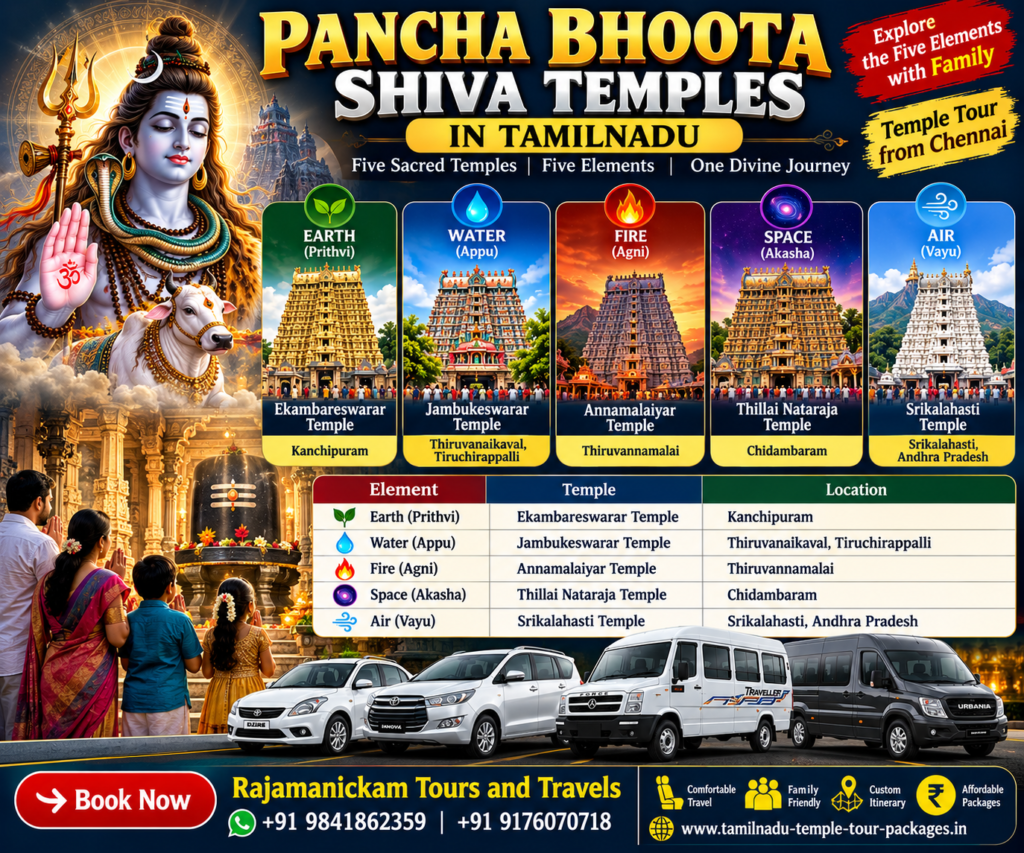
Four Pancha Bhoota Shiva Temples in TamilNadu
The Pancha Bhoota Shiva Temples in Tamilnadu are five sacred temples dedicated to Lord Shiva, each representing one of the five natural elements — Earth, Water, Fire, Air, and Space. These ancient temples are popular pilgrimage destinations for devotees seeking a spiritual Pancha Bhoota Sthalam Temple Tour.
A Pancha Bhoota Shiva Temple Tour from Chennai is an excellent way to explore these historic temples, including Ekambareswarar Temple in Kanchipuram, Jambukeswarar Temple near Tiruchirappalli, Arunachaleswarar Temple in Tiruvannamalai, and Thillai Nataraja Temple in Chidambaram, along with Srikalahasti in Andhra Pradesh.
With Pancha Bhoota Sthalam tour packages, travelers can choose 3-day, 4-day, 5-day, or customized itineraries by car, Tempo Traveller, or Urbania.
Are All Pancha Bhoota Temples in Tamil Nadu?
Not all. Four Pancha Bhoota Sthalams lie in Tamil Nadu: Kanchipuram, Thiruvanaikaval, Thiruvannamalai and Chidambaram. The air element temple, Srikalahasti, is in Andhra Pradesh, about 110 km from Chennai. Most devotees include it in the same circuit because it is easy to reach from Tamil Nadu.
Pancha Bhoota Shiva Temples in TamilNadu: Quick List

| Element | Temple | Location |
|---|---|---|
| Earth (Prithvi) | Ekambareswarar Temple | Kanchipuram |
| Water (Appu) | Jambukeswarar Temple | Thiruvanaikaval, Tiruchirappalli |
| Fire (Agni) | Annamalaiyar Temple | Thiruvannamalai |
| Space (Akasha) | Thillai Nataraja Temple | Chidambaram |
| Air (Vayu) | Srikalahasti Temple | Srikalahasti, Andhra Pradesh |
1. Ekambareswarar Temple, Kanchipuram (Earth)
Kanchipuram, known as the city of a thousand temples, is home to the earth-element shrine. Tradition says Goddess Parvati made a lingam of sand here and worshipped it. The temple is known for its tall gopuram, its large halls with many pillars and an ancient mango tree in the premises. Kanchipuram is about 75 km from Chennai, so it works well as a starting point.
2. Jambukeswarar Temple, Thiruvanaikaval (Water)
Located near Srirangam in Tiruchirappalli, this temple represents the water element. The sanctum houses the Appu Lingam, and water is associated with the inner shrine. The temple takes its name from the jambu tree linked to its legend. It can be combined with a visit to nearby Srirangam and other Trichy temples.
3. Annamalaiyar Temple, Thiruvannamalai (Fire)
The fire element is represented by the sacred Arunachala hill and the large temple at its foot. It is famous for the Karthigai Deepam festival, when a great lamp is lit on the hilltop. Many devotees also walk the Girivalam path around the hill, about 14 km, especially on full moon days.
4. Thillai Nataraja Temple, Chidambaram (Space)
Chidambaram represents the space element. Shiva is worshipped here as Nataraja, the lord of cosmic dance. The Chidambara Rahasyam presents space itself as an object of worship, shown as an empty area behind a curtain. It is also counted among the Pancha Sabhai (five dance halls) of Shiva.
5. Srikalahasti Temple (Air), Just Outside Tamil Nadu
Chidambaram represents the space element. Shiva is worshipped here as Nataraja, the lord of cosmic dance. The Chidambara Rahasyam presents space itself as an object of worship, shown as an empty area behind a curtain. It is also counted among the Pancha Sabhai (five dance halls) of Shiva.
Route and Distances (Approximate, from Chennai)
| Route | Distance |
|---|---|
| Chennai to Srikalahasti | ~110 km |
| Srikalahasti to Kanchipuram | ~120 km |
| Kanchipuram to Thiruvannamalai | ~100 km |
| Thiruvannamalai to Chidambaram | ~155 km |
| Chidambaram to Thiruvanaikaval | ~180 km |
Distances vary with the route and road conditions, so check a live map before you travel.
- 3 days: Possible with early starts and a tight schedule.
- 4 days: The most comfortable pace for families and senior citizens.
- 5 days: Ideal if you want extra time for Girivalam or nearby temples.
Pancha Bhoota Shiva Temples Tour Package from Chennai

| Duration | Details |
|---|---|
| 2 Nights / 3 Days Pancha Bhoota Sthalam Package | View Price |
| 3 Nights / 4 Days Pancha Bhoota Temples Tour Package | View Price |
| 4 Nights / 5 Days Pancha Lingas Tour Package | View Price |
Distances vary with the route and road conditions, so check a live map before you travel.
Best Time to Visit
October to February is the most pleasant season for temple travel in Tamil Nadu. Summers are hot, so start early and carry water. Festival periods such as Karthigai Deepam and Maha Shivaratri bring large crowds, so book stays in advance.
Travel Tips
- Wear modest, traditional clothing, as several temples have dress codes.
- Check darshan timings, since many temples close in the afternoon.
- Carry water, snacks, basic medicines and easy-to-remove footwear.
- Confirm photography and mobile phone rules at each temple.
- Book hotels early in Thiruvannamalai and Chidambaram during festivals.
- Allow buffer time for traffic and queues.
Plan Your Tour from Chennai
If you prefer a hassle-free trip, you can book a guided Pancha Bhoota tour with Rajamanickam Tours and Travels.
📞 Call / WhatsApp: +91 9841862359 | +91 9176007718
🌐 Website: www.tamilnadu-temple-tour-packages.in
Frequently Asked Questions
How many Pancha Bhoota Shiva temples are in Tamil Nadu?
Four: Kanchipuram, Thiruvanaikaval, Thiruvannamalai and Chidambaram. The fifth, Srikalahasti, is in Andhra Pradesh.
Which Pancha Bhoota temple represents fire?
The Annamalaiyar Temple in Thiruvannamalai.
Which Pancha Bhoota temple represents water?
The Jambukeswarar Temple in Thiruvanaikaval.
Can I visit all five temples in one trip from Chennai?
Yes, most devotees finish the circuit in 3 to 4 days by road.
What is the best time to visit?
October to February.
Conclusion
The Pancha Bhoota Shiva temples in Tamil Nadu offer a rich mix of devotion, history and Dravidian architecture. With a clear route and early planning, you can cover all five elemental shrines comfortably.